
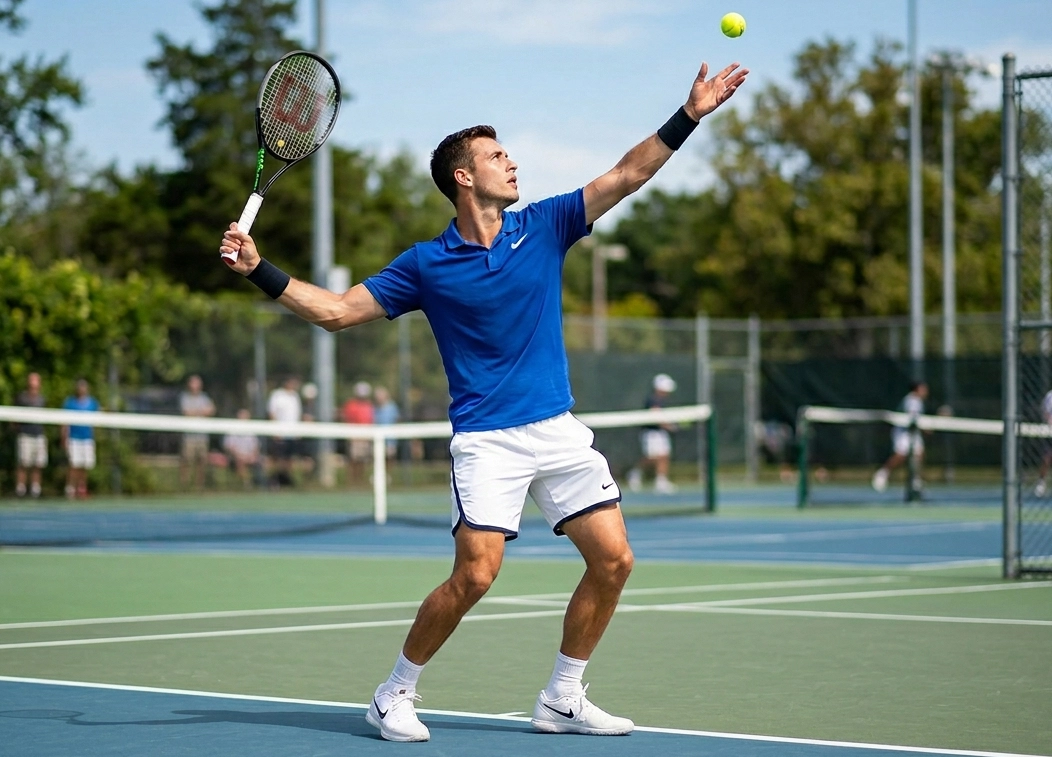
Ask any tennis player what took the longest to learn, and the serve will almost always top the list. It’s the one shot you practice alone, at your own pace — and yet it still manages to feel impossibly complicated. The good news? Breaking it down into its core parts makes it a lot less overwhelming. Here’s what you need to know.
Why the Serve Matters More Than You Think
The serve is unique: it’s the only shot in tennis where your opponent has no say. You pick the pace, the placement, the spin. Done well, it puts your opponent immediately on the defensive — scrambling to respond rather than setting up their own attack. A strong serve can keep them pinned behind the baseline, expose a weaker side, and hand you easy points before the rally even begins. It’s not just a way to start the point; it’s a weapon.
The Building Blocks of a Good Serve
Before worrying about power or spin, get comfortable with the fundamentals. They’re what everything else is built on.
Stance and positioning. Stand with your feet roughly shoulder-width apart, body weight balanced evenly. Your front foot should angle toward the net post, not point straight ahead. This small detail makes a big difference in your ability to rotate through the shot.
Grip. Use a continental grip — imagine holding a hammer, with the base knuckle of your index finger on the top bevel of the handle. It feels awkward at first if you’re used to a forehand grip, but it’s essential for generating spin and keeping the ball in. Firm, not strangling.
The ball toss. This is where most beginners quietly fall apart. The toss needs to be consistent — same height, same position, every single time. Toss slightly in front of you and a little to the right (for right-handers), and keep your arm straight as you release. If your toss is all over the place, your serve will be too.
Racket contact. Make contact at full arm extension, at the peak of the toss. Aim for the center of the ball and think about brushing up and over it slightly — this is what gives your serve its arc and keeps it from sailing long.
How to Actually Improve
Knowing the theory is one thing. Here’s how to make it stick in practice:
- Isolate the toss. Seriously, just stand and toss the ball repeatedly without hitting it. It sounds boring, but an inconsistent toss is the root cause of most serve problems. You want the ball to land on roughly the same spot on the court every time you let it drop.
- Slow it down. Practice the motion in stages — trophy position, then contact, then follow-through — before putting it all together. Muscle memory is built slowly.
- Use your legs. A lot of beginners serve with just their arm and wonder why it feels weak. Bend your knees on the backswing and push upward as you swing. Your legs and core generate far more power than your shoulder ever will.
- Record yourself. Even a quick phone video from the side reveals things you can’t feel in the moment — a low toss, a bent elbow at contact, a choppy follow-through.
The Most Common Problems (and How to Fix Them)
Inconsistent toss — slow down, simplify, and toss without hitting. Repeat until it’s automatic.
Weak contact — check that you’re making contact at full extension, not with a bent arm. A low toss forces you to bend; fix the toss and the contact often sorts itself out.
No power — you’re probably not using your legs. Try exaggerating the knee bend in practice until it starts to feel natural.
Double faulting under pressure — reduce pace on the second serve and focus on spin over speed. A slower ball that lands in is infinitely more useful than a fast one that doesn’t.
The serve takes longer to master than almost any other shot in tennis, but that’s also what makes getting it right so satisfying. Be patient with yourself, focus on one piece at a time, and trust that the repetitions add up. Before long, stepping up to the baseline will feel less like a source of anxiety and more like an opportunity.